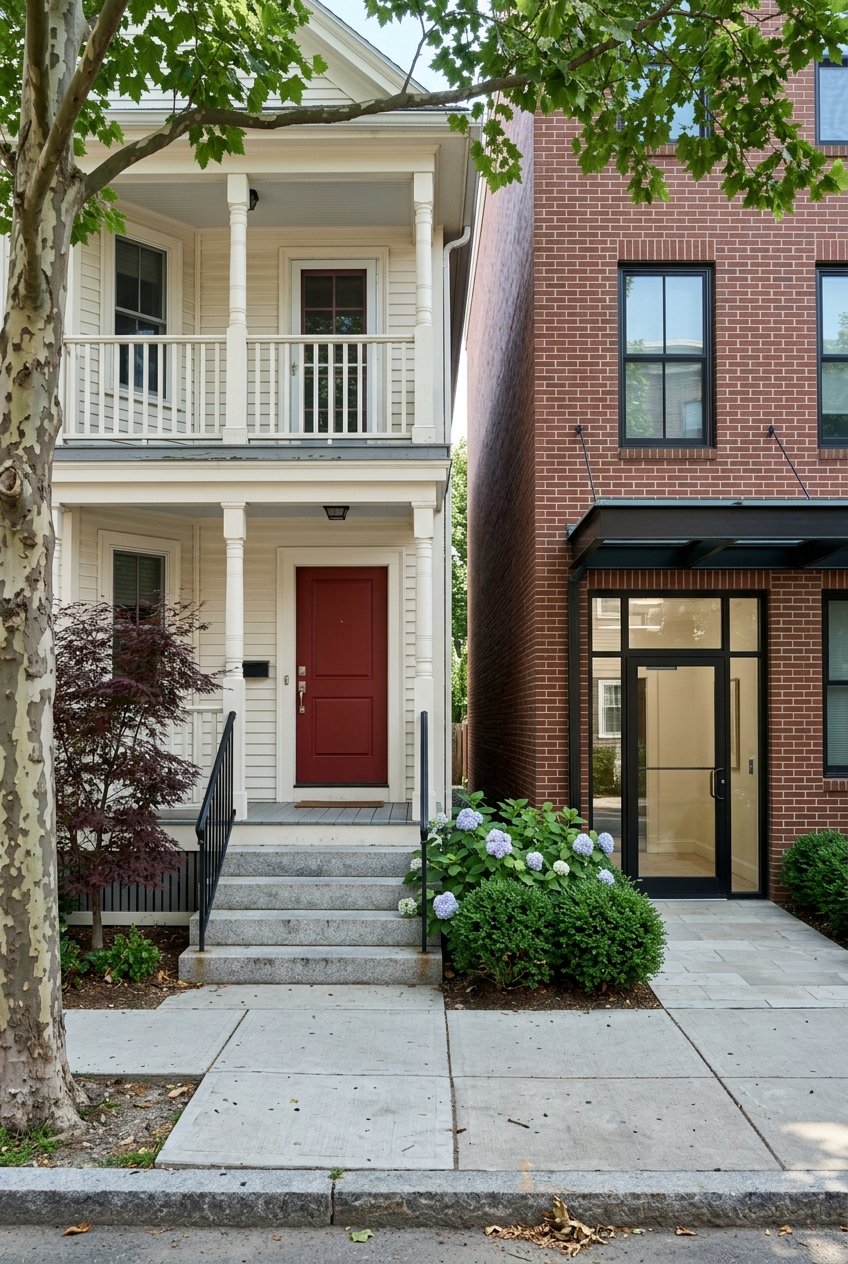
Wondering whether a Cambridge condo or a triple-decker is the smarter move? You are not alone. In a city shaped by multifamily housing for generations, the right fit often comes down to how you want to live, what kind of upkeep you can handle, and how much control you want over your home. This guide will help you compare the two through a practical Cambridge lens so you can move forward with more clarity and confidence. Let’s dive in.
Why this choice matters in Cambridge
Cambridge is a strongly multifamily city, and that matters when you start comparing property types. City design guidance notes that multifamily housing has been part of Cambridge’s housing stock since the mid-19th century, including triple-deckers, fourplexes, and larger apartment or condominium communities.
The city’s housing inventory also shows how common these options are. As of June 30, 2025, 34.1% of dwelling units were in properties with more than 100 units, 10.5% were in 3-unit properties, and 27.6% of citywide dwelling units were condominiums. In other words, both condos and triple-deckers are part of everyday Cambridge housing, but they tend to offer very different ownership experiences.
Cambridge prices at a glance
Price is often the first filter, but it helps to read the numbers carefully. Cambridge’s 2024 median market-rate sale price was $870,000 for condominiums and $1,822,500 for three-family homes, while Redfin reported a citywide median sale price of $1.4M in March 2026.
The condo versus three-family comparison is best used as a broad budget signal, not a one-to-one matchup. The three-family figure reflects the entire building, not a single unit. If you are choosing between a condo unit and buying a whole triple-decker, your budget, financing approach, and long-term responsibilities may look very different from day one.
How condo ownership works
In Massachusetts, a condominium is created by recording a master deed under Chapter 183A. That legal framework gives each unit owner an undivided interest in the common areas and facilities, which can include spaces like basements, yards, gardens, parking areas, recreational areas, and storage spaces.
It also creates an organization of unit owners that oversees management and maintenance. Common expenses are assessed to unit owners based on their interest or unit area, and some limited common areas may be assigned directly to the unit that uses them. In simple terms, condo ownership usually means you share costs, decisions, and building responsibilities with other owners.
What that means for daily life
A larger condo building is often a good fit if you want shared upkeep and a more structured approach to maintenance. If a roof, entry system, or common hallway needs work, those issues are generally handled through the association rather than by one owner acting alone.
That structure can make ownership feel more predictable, especially if you prefer formal management and clearer systems for handling building needs. The tradeoff is that you will usually have less direct control over timing, vendor choices, and certain shared decisions.
How triple-decker ownership differs
Cambridge’s resilience study describes double and triple-deckers as one- to three-family buildings that are usually two to three stories tall, often pre-1900, and typically wood-frame with vinyl or wood siding. These homes commonly use gas or fuel-oil boilers and often rely on window air conditioning rather than central cooling.
The same study contrasts newer multifamily buildings as larger properties that often have higher-efficiency systems, better insulation, and newer windows. For you as a buyer, that usually means a triple-decker can offer a more hands-on, house-like ownership experience, but it may also come with older systems that need closer attention over time.
One important legal detail
Not every triple-decker is a condo. If a triple-decker has been submitted under Chapter 183A, it becomes a condominium. If it has not, it remains a multi-unit property rather than a condo association.
That distinction matters because the ownership structure shapes everything from maintenance obligations to decision-making. If you are looking at a Cambridge triple-decker, you will want to know whether you are buying a condo unit within the building or buying the building itself.
Condos vs triple-deckers: the lifestyle tradeoff
At a high level, condos and triple-deckers often appeal to different priorities. Neither is automatically better. The better option is the one that aligns with how you want to spend your time, manage your budget, and live within the building.
Here is a simple side-by-side view:
| Consideration | Condo | Triple-Decker |
|---|---|---|
| Maintenance | Shared through an owner organization | More direct owner responsibility |
| Decision-making | Shared with other owners | More autonomy, depending on ownership structure |
| Building systems | Often newer in larger buildings | Often older, especially in pre-1900 properties |
| Setting | Common in transit-rich, mixed-use areas | Common on smaller-scale residential blocks |
| Ownership feel | Structured and communal | More independent and house-like |
Where each property type tends to fit
Cambridge neighborhoods can help you picture how each option feels in real life. City neighborhood descriptions show a range of settings, from dense residential blocks to revitalizing mixed-use districts.
East Cambridge is one of the city’s oldest residential neighborhoods and has grown from industrial land into a commercial and retail center. North Point is described as a revitalizing mixed-use neighborhood with large rental and condominium housing developments. Those areas may feel more natural if you are drawn to larger condo buildings and an urban, transit-oriented setting.
Cambridgeport is described as dense and diverse, while Wellington-Harrington is a small, high-density residential neighborhood with many three-story homes set close together. North Cambridge includes both single- and multi-family homes along with larger apartment buildings. These patterns suggest that triple-deckers often feel more at home on smaller-scale residential blocks with a more house-like streetscape.
Why street context matters
Cambridge design guidelines emphasize context, common spaces, neighborly massing, and harmony with history. That matters because your day-to-day experience is not just about the unit itself. It is also about how the building sits on the block and how that block functions around you.
If you want a more mixed-use environment with larger buildings nearby, a condo may feel more intuitive. If you want a classic Cambridge residential rhythm with closely spaced three-story homes, a triple-decker may feel more aligned.
Questions to ask before you choose
When clients compare Cambridge condos and triple-deckers, the best decision usually comes from a few practical questions. Your answers can reveal the right fit faster than scrolling through listings alone.
How much decision-making do you want to share?
With a condo, building decisions and common expenses are shared through the owner organization. That can be helpful if you want a system in place for maintenance and long-term planning.
With a triple-decker or other small multi-unit property, you may have more direct control. For some buyers, that feels freeing. For others, it feels like one more layer of responsibility.
How much upkeep do you want to absorb?
If you value organized common maintenance, a condo often checks that box. If you prefer a smaller building and do not mind taking a closer look at building needs over time, a triple-decker may suit you better.
This is especially important in Cambridge, where many triple-deckers are older structures. The age of the envelope and mechanical systems can have a real impact on future maintenance demands.
How important are newer systems and efficiency?
Newer multifamily buildings in Cambridge often have better insulation, newer windows, and higher-efficiency systems. That can be appealing if you want a more updated physical plant.
Triple-deckers, by contrast, often carry the character of older Cambridge housing. That charm can be a major draw, but it should be weighed alongside the reality of older heating, cooling, and exterior systems.
What kind of neighborhood setting feels right?
Some buyers want a denser, mixed-use setting near larger residential buildings. Others want a smaller-scale street with a more traditional house-like pattern.
Cambridge offers both. Choosing between a condo and a triple-decker is often also a choice about the block, the streetscape, and the rhythm of daily life around you.
A practical way to decide
If you are still torn, try this simple framework:
- Choose a condo if you want shared upkeep, more formal building management, and a property type that often fits naturally in mixed-use, transit-rich parts of Cambridge.
- Choose a triple-decker if you want a smaller-building feel, more autonomy, and a classic Cambridge street presence, while accepting the realities that often come with older systems.
- Focus your due diligence on the right issue for the property type.
- For a condo, ask how the association handles common expenses and maintenance.
- For a triple-decker, ask about the age and condition of the envelope and mechanical systems, plus how much ongoing work you are prepared to manage.
The Cambridge lens matters most
In another city, this choice might be mostly about price or square footage. In Cambridge, it is also about housing history, legal structure, street context, and how much of the building experience you want to manage yourself.
That is why a thoughtful comparison matters. The right property is not just the one that looks good online. It is the one that fits your budget, your tolerance for upkeep, and the kind of Cambridge living experience you want over the long term.
If you are weighing condos against triple-deckers in Cambridge, The Agency Boston can help you evaluate the tradeoffs with clarity, from ownership structure to renovation potential to neighborhood fit.
FAQs
What is the main difference between a Cambridge condo and a Cambridge triple-decker?
- A Cambridge condo usually involves shared ownership of common areas and shared maintenance through an owner organization, while a triple-decker usually offers a smaller-building feel and more direct responsibility for the property, depending on its legal structure.
Are Cambridge triple-deckers always condominiums?
- No. A triple-decker becomes a condominium only if it has been submitted under Massachusetts Chapter 183A. Otherwise, it remains a multi-unit property rather than a condo association.
Is a Cambridge condo usually less expensive than a Cambridge triple-decker?
- As a broad budget signal, yes. Cambridge’s 2024 median market-rate sale price was $870,000 for condominiums and $1,822,500 for three-family homes, but the three-family figure reflects the entire building, not a single unit.
Which Cambridge neighborhoods tend to have larger condo buildings?
- City neighborhood descriptions suggest that larger condo buildings often feel most natural in transit-rich, mixed-use areas such as North Point and parts of East Cambridge.
What should you review before buying a Cambridge condo?
- The key question is how the condo association handles common expenses and maintenance, since those shared systems shape both your costs and ownership experience.
What should you review before buying a Cambridge triple-decker?
- Focus on the age and condition of the building envelope and mechanical systems, since many Cambridge triple-deckers are older properties that may require more direct upkeep over time.